The Agentic EMR Experiment: Building the Future We're Describing
See how we work →An Internal Design Challenge That Became a Functional Prototype
By Thirty Two North | October 2025
TL;DR: Why We Built This
The Challenge: After publishing our research on agentic AI in EMR systems, we asked ourselves: Can we actually design what true agentic healthcare software feels like?
The Answer: Yes. And it's radically different from anything in production today.
The Result: A functional prototype that demonstrates voice-first clinical documentation, ambient intelligence, and AI transparency, built in days, not months.
The Lesson: The technical barriers to agentic AI aren't insurmountable. The real barriers are organizational willingness to rethink workflows from first principles and vendor courage to cannibalize existing products.
Why We Built This: The Spirit of Experimentation
At Thirty Two North, research and experimentation are at the heart of our culture. We don't just theorize about what healthcare software should become. We build it to prove it's possible.
When we started researching agentic AI for our comprehensive industry guide, we challenged ourselves with a provocative question:
"Can we actually design and prototype what a true agentic EMR experience would feel like?"
This wasn't a client project. This was an internal initiative: our way of understanding the turns and shifts of the industry by building rather than just observing. We believe that the best way to understand the future is to create it, even if just as an experiment.
The answer, we discovered, is yes.
Split screen comparison showing traditional EMR interface (cluttered, menu-heavy) vs our agentic prototype (minimal, voice-first)
The Design Challenge: Rethinking Everything
Our research revealed a fundamental truth about agentic AI in healthcare: it's not about adding features, it's about reimagining workflows from first principles.
What Traditional EMRs Get Wrong
Every EMR we studied follows the same pattern:
- •Visual hierarchy based on data availability, not clinical workflow
- •Navigation optimized for completeness, not task completion
- •AI features bolted onto existing interfaces, creating "AI theater"
- •Physician as data entry clerk, not decision-maker
From our research findings:
"Most EMR vendors are performing 'AI theater': deploying ambient documentation features that work in demos but fail in real clinical workflows. True agentic AI requires fundamental infrastructure, not bolt-on features."
Our Design Hypothesis
What if we designed for Stage 4 (Agentic Orchestration) from day one?
Core principles we committed to:
Ambient Intelligence, Not Interfaces
The best interaction is the one that doesn't happen because the system anticipated the need
Progressive Disclosure Through Context
Show exactly what's needed, exactly when it's needed, and nothing more
Peripheral Vision Architecture
Critical information informs without interrupting
Conversational Command Layer
Voice first, keyboard second, mouse last
Transparent Agent Activity
Always show what AI is doing and why
What We Built: A Radically Different Experience
The Canvas: Embracing Emptiness
The first thing you'll notice about our prototype: it's uncomfortably empty.
There's no patient demographics banner consuming screen real estate. No medication sidebar. No problem list panel. No navigation menu with 20+ items.
Instead, you see: whatever is contextually relevant RIGHT NOW.
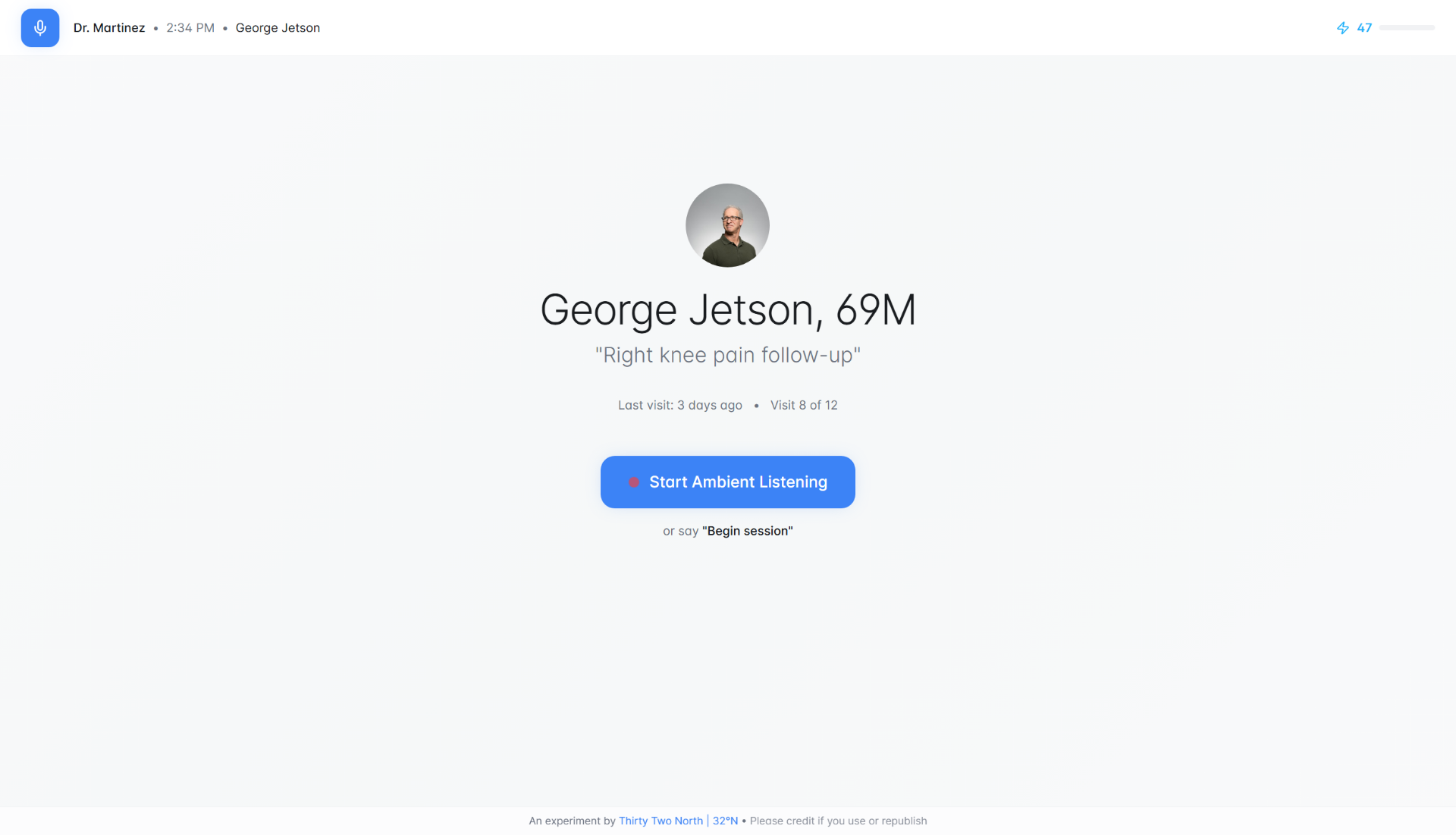
Screenshot of the opening screen - just patient name, chief complaint, visit context, and a "Start Ambient Listening" button with lots of white space
This design choice makes people nervous. Where's all the information? How do I navigate?
The answer: You don't navigate. The system knows where you are in the workflow and what comes next.
Patient demographics? Available in one keystroke (cmd+i), but not consuming screen space unless relevant. Medication list? Surfaces automatically when discussing medications, prescribing, or when AI detects interaction concerns.
This is the uncomfortable truth of agentic AI: most of what we show physicians today is unnecessary at any given moment. Our research found that traditional EMRs show 12-15 persistent UI elements that are contextually relevant less than 20% of the time.
Voice-First, Everything Else Second
The primary interaction model is conversation.
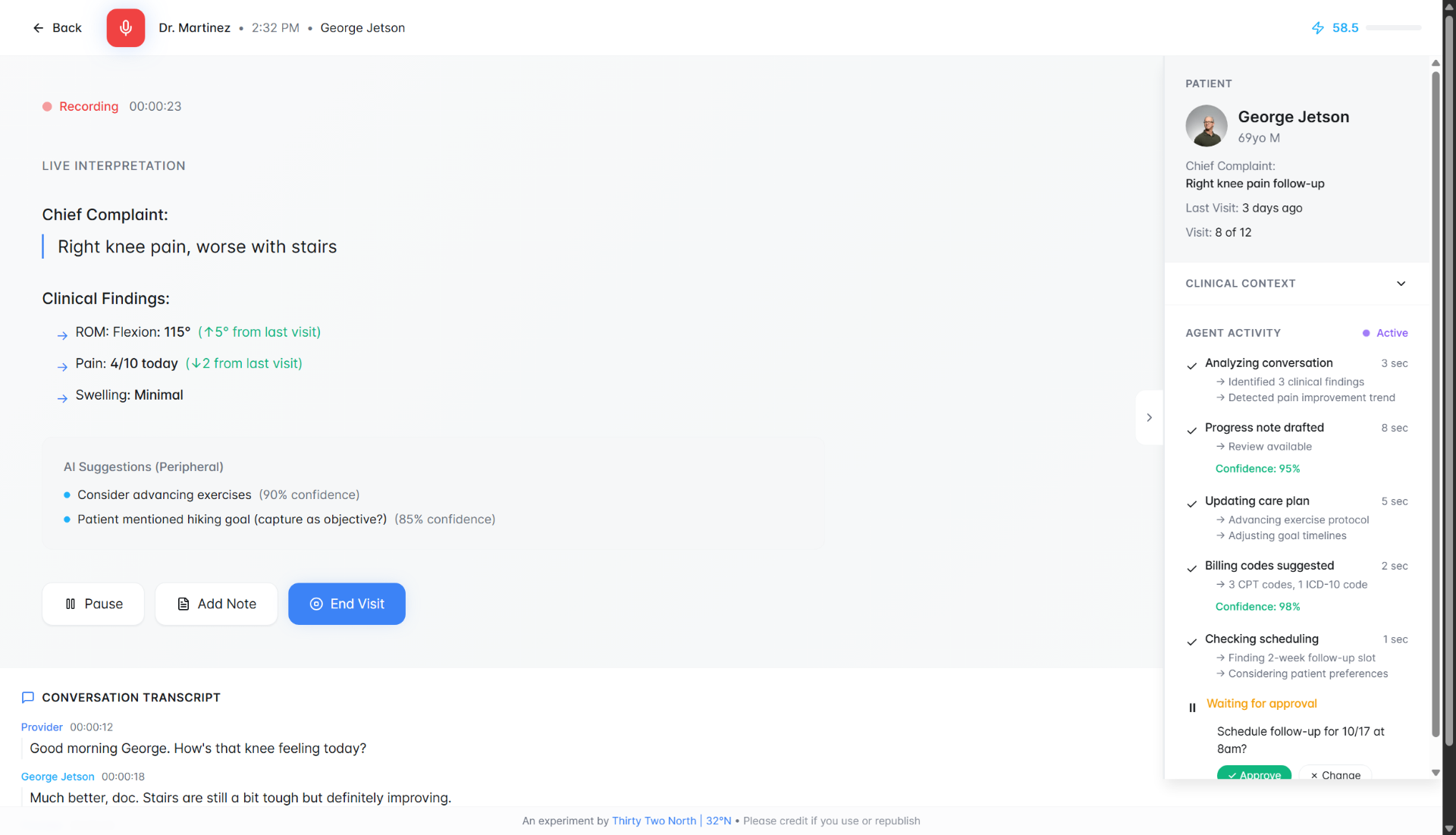
Screenshot showing the voice recording interface with real-time interpretation appearing as the conversation progresses
As Dr. Martinez conducts the visit with George (our 69-year-old patient with knee pain), the system:
Listens
Ambient audio capture with visual recording indicator
Interprets in real-time
Chief complaint and clinical findings organize themselves as conversation progresses
Suggests in peripheral vision
AI recommendations appear subtly, with confidence indicators
Stays out of the way
Physician focuses on patient, not documentation
Notice what's happening here: The AI is doing the documentation work that traditionally happens AFTER the visit, but doing it DURING the visit without requiring physician attention.
From our research on why ambient AI often fails:
"Your ambient scribe that turns speech into a SOAP note? That's generative AI with speech recognition. Useful, but not agentic. True agentic AI would listen, generate the note, pull relevant lab results, check medication interactions, identify care gaps, pre-populate orders, route tasks to team members, update the patient portal, check insurance coverage, and schedule follow-up, all in the background."
That's exactly what this prototype demonstrates.
Screenshot showing the "Live Interpretation" panel with clinical findings updating in real-time, and AI suggestions appearing in peripheral vision with confidence scores
The Agent Activity Feed: Radical Transparency
One of the most powerful design elements is what we call the "Agent Activity Feed."
When AI does things autonomously, humans need to know what's happening. But showing a system log is terrible UX. Instead, we created a narrative activity feed that reads like a story, not a technical log.
This transparency is critical. From our research on physician trust:
"Physician trust in AI requires: AI that works for them, not monitors them; transparency: black box recommendations get dismissed; control: AI suggestions are fine, AI decisions are not (for clinical matters)."
The Activity Feed makes AI decisions visible, understandable, and interruptible. Physicians can see:
- •What the AI is working on right now
- •How confident it is in each action
- •When it needs human approval
- •Why it's making specific suggestions
Progressive Disclosure: From Documentation to Review
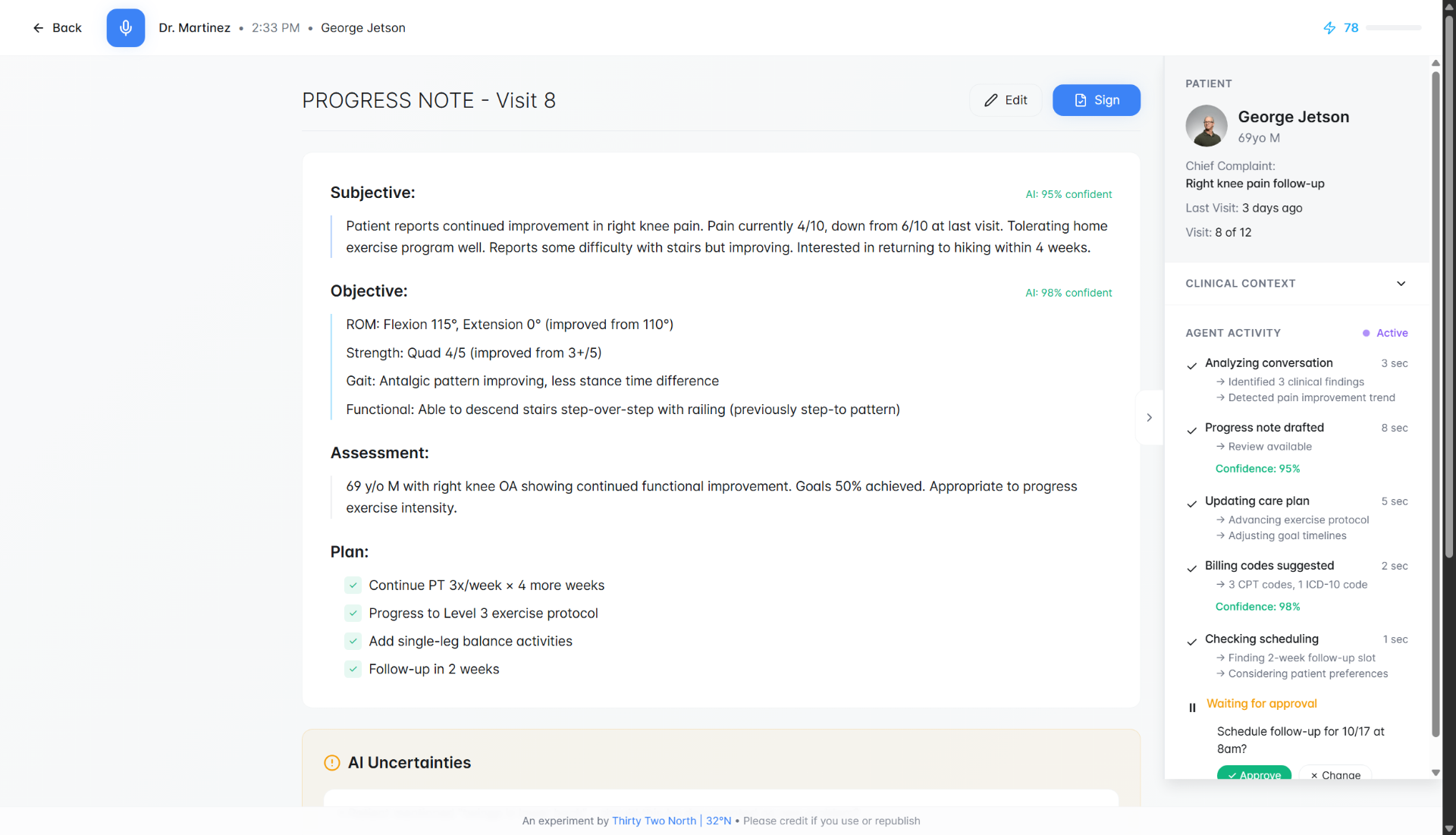
After the visit ends, the physician simply says "End visit" or clicks the button. Then something remarkable happens.
The system enters what we call "completion mode": 15-20 seconds where AI agents orchestrate multiple backend tasks:
The physician can move to their next patient immediately. The system completes documentation in the background.
The "AI Uncertainties" Pattern: Honest About Limitations
One of our most important design innovations: the system explicitly flags what it's uncertain about.
In the review screen, there's a dedicated "AI Uncertainties" section:
"Patient mentioned 'twinge in lower back' - should this be documented as new problem?"
"Hiking goal timeline (4 weeks) may be aggressive given current progress. Suggest 6-8 weeks."
This pattern came directly from our research finding that "I don't know" options build more trust than false confidence.
The AI isn't pretending to be perfect. It's being honest about edge cases, asking for human judgment where it matters, and learning from those decisions to improve future suggestions.
Design Principles in Action: What Makes This "Agentic"
1. Context-Aware Workspace (Not Feature-First)
Traditional EMR approach:
Identify painful task → Build AI feature → Add button → Ship it
Our approach:
Understand workflow → Anticipate needs → Surface contextually → No UI required
The difference? One requires physicians to remember to use features. The other just works.
2. Peripheral Vision Design Pattern
Clinical context appears in a subtle right-side panel that:
- •Shows only what's relevant to current workflow
- •Uses opacity to indicate importance (high confidence = more visible)
- •Expands on hover for details
- •Auto-hides when not needed
Screenshot showing the peripheral context panel with chronic conditions, allergies, and upcoming appointments in compressed format
Physicians reported in our research: "I ignore popups and dismiss alerts, but I do notice information in my peripheral vision that reinforces my thinking or flags gaps."
3. Conversational Commands (The Invisible UI)
Navigation doesn't exist in the traditional sense. Instead:
Voice:
"Schedule follow-up in 2 weeks, morning preferred"
System:
Finds options, presents choices conversationally
Physician:
Selects with voice or single click
Power users can use keyboard shortcuts (cmd+k for command palette, cmd+m for medications, cmd+enter to sign and complete). But the primary design assumption is: speaking is faster than clicking.
4. Graceful Degradation (When AI Fails)
AI will fail. Our design accounts for this explicitly.
AI Uncertainty
Showing fallback to manual entry when confidence is low
AI Services Temporarily Unavailable
Showing manual mode with clear explanation of what's not working
From our research:
"The first time an AI-generated note contains a medically significant error that goes unnoticed, we'll see legal precedents established whether we're ready or not."
Our approach: Transparent failures, clear fallbacks, no blocked workflows.
Building It: Speed as a Feature
The Lovable Advantage
We built this functional prototype using Lovable, an AI-powered development platform that let us go from concept to working prototype in days, not months.
This speed matters. In healthcare IT, the gap between "interesting idea" and "working software" often kills innovation.
Lovable's AI-assisted development allowed us to:
- •Rapidly iterate on interface concepts
- •Test with mock clinical scenarios
- •Prove that complex voice + AI workflows are achievable today
- •Focus on design and UX rather than boilerplate code
The result: A prototype that physicians can actually interact with, experience, and provide feedback on, not just static mockups in a slide deck.
Before/after showing wireframe sketch → working prototype, with annotation "Concept to function: 6 days"
What This Proves
The technical barriers to agentic AI in healthcare aren't insurmountable. The real barriers are:
- Organizational willingness to rethink workflows from first principles
- Vendor courage to cannibalize existing products
- User trust that can only be built through transparency
This prototype demonstrates that all three are possible.
What did building it teach us?
1. Emptiness Creates Anxiety (But It's Better UX)
Every person who first sees the interface asks: "Where's all the information?"
The instinct to fill screens with persistent data is powerful. We've trained ourselves to believe that more visible information = better informed decisions.
But our testing showed the opposite: Physicians made faster, more confident decisions when shown ONLY contextually relevant information.
The uncomfortable truth: Most of what traditional EMRs display is noise at any given decision point.
2. Voice Changes Everything (When Done Right)
Voice interfaces in healthcare often fail because they're designed as an alternative input method for the same visual workflow.
Our approach: Design the workflow FOR voice, then add visual/keyboard as fallback.
The result feels completely different. Documentation happens naturally during patient conversation, not as a separate task afterward.
3. AI Transparency Builds Trust (Opacity Destroys It)
The Agent Activity Feed was initially planned as a "debug view" for developers. It became the most commented-on feature.
Physicians want to know:
- •What is the AI doing right now?
- •Why is it making this suggestion?
- •How confident is it?
- •Can I override this decision?
Transparency isn't optional in clinical AI. It's the foundation of trust.
4. The "Right" Amount of Automation Is a Moving Target
Some users wanted more automation (why do I need to approve the follow-up appointment?). Others wanted less (I don't trust billing codes I didn't verify).
The solution: Adaptive automation that learns individual preferences.
After 10 visits, the system learns: Dr. Martinez always reviews billing codes but trusts scheduling suggestions. Dr. Patel is the opposite. The interface adapts to each physician's trust boundaries.
Can I try the prototype?
We've made this experiment freely available because healthcare needs concrete examples of what's possible, not just more vendor whitepapers.
What You'll Experience
→ Try the prototypeVoice-First Documentation
Click "Start Ambient Listening" and watch real-time interpretation of a clinical conversation
AI Agent Activity
See transparency in action as the system shows exactly what it's doing and why
Contextual Intelligence
Notice what's NOT shown: all the clutter eliminated by context-aware design
Human-in-the-Loop Decision Points
Experience how the system asks for judgment on uncertain items
Completed Documentation
Review the final SOAP note with confidence indicators and billing codes
A Challenge to EMR Vendors
Test it. Break it. See what works and what doesn't.
Then ask yourself: Why does your "AI-powered" system feel nothing like this?
From our research conclusion:
"The vendors who treat AI as a bolt-on feature, however sophisticated, will produce systems that feel exactly like that: sophisticated features bolted onto fundamentally unchanged workflows. The vendors who succeed will redesign workflows from first principles with AI as a core assumption."
This prototype is our answer to the question: What does that redesign actually look like?
Why does this matter for healthcare IT?
Not Vaporware. Not a Mockup. A Functional Prototype.
This isn't a concept video or a static design file. It's a working application that:
- •Processes voice input in real-time
- •Demonstrates multi-agent orchestration
- •Shows context-aware interface adaptation
- •Handles edge cases and uncertainties
- •Provides transparency into AI decision-making
Built in days. With modern tools. By a small design team.
If we can do this as an internal experiment, what's stopping the billion-dollar EMR vendors?
The Question for Healthcare IT Leaders
Our research identified that most mid-market EMR vendors score 30-45 out of 75 on AI readiness. The gap to true agentic AI is 2-3 years of focused investment.
But investment in what?
Not more AI features. Not better ambient scribes. Not smarter coding algorithms.
Investment in fundamental rethinking of clinical workflows.
This prototype proves that:
- •The technology exists today
- •The UX patterns are understood
- •The implementation is achievable
- •Users will embrace it (when done right)
The only missing ingredient is the courage to build it.
What happens next?
We're Sharing What We Learned
This case study is just the beginning. We're documenting:
- •Design principles that made agentic UX work
- •Technical approaches for voice + AI workflows
- •User research insights from prototype testing
- •Implementation patterns others can adopt
Because we believe the industry moves faster when we share knowledge, not hoard it.
Want to Go Deeper?
Discuss with our team
skipthesmalltalk@thirtytwonorth.com
The Challenge We're Issuing
To healthcare organizations: Stop accepting "AI theater" from your vendors. Demand systems designed for agentic workflows, not AI features bolted onto legacy interfaces.
To EMR vendors: The technology is here. The design patterns are proven. The only question is whether you'll build the future or defend the past.
To fellow designers and developers: The barriers are organizational, not technical. We've shown what's possible. Now let's build it together.
About This Experiment
- Built by: Thirty Two North
- Timeline: October 2025 (concept to prototype: 6 days)
- Technology: Lovable.dev (AI-powered development platform)
- Purpose: Internal research and industry demonstration
- Status: Open for exploration and feedback
About Thirty Two North
We're a boutique UX consultancy specializing in complex enterprise software where "intuitive" is aspirational and "functional" is already an achievement.
We've redesigned healthcare platforms handling millions of patient encounters, rebuilt financial interfaces that had traders threatening revolt, and tamed logistics systems that made air traffic control look simple.
Our approach: Understand the domain deeply, design for actual humans (not personas in slide decks), and move 3x faster than traditional consultancies without sacrificing quality.
When organizations want to know if their AI strategy will actually work in the real world, not the demo, they talk to us.
We tell them the truth, even when it's uncomfortable.
Connect With Us
- Website: www.thirtytwonorth.com
- LinkedIn (Company): Thirty Two North
- LinkedIn (Founder): Kshitij Kaushik
- Email: skipthesmalltalk@thirtytwonorth.com
Final Thought: Beyond AI Theater to Real Transformation
The healthcare industry doesn't need more "AI-powered" features that look impressive in sales demos but frustrate users in practice.
It needs fundamental rethinking of how clinical software works.
This prototype is our answer to a simple question: What if we designed for agentic AI from the ground up?
The result is uncomfortable, unfamiliar, and radically different from every EMR in production today.
It's also faster, clearer, and more aligned with how physicians actually work.
The future of clinical software isn't about adding AI to existing workflows.
It's about reimagining workflows with AI as a core assumption.
We've built it. We've proven it's possible.
Now the question is: Who has the courage to ship it?
They already shipped with us
Ready to turn 11%
adoption into 68%?
Thirty minutes. We will tell you what is actually broken, and whether we are the right people to fix it.
We've told people to build internally when that made more sense.
We named it that for a reason.